Coffee Table & Console Table Styling Guide: Shapes, Heights and Materials That Pair With Your Sofa
The coffee table and console table are two of the most enduring pieces in Western furniture design (the coffee table itself dates back to Victorian Britain), yet they're also the pieces people spend the least time choosing and the most time regretting. A coffee table that sits too high next to a low-slung sofa throws off the whole room, and a console table wedged behind a sofa that's six centimetres too deep becomes a permanent obstacle course. Getting the shapes, heights and materials right isn't complicated, but it does take knowing a few real numbers rather than guessing.
Getting the height right
The rule interior designers use is simple: a coffee table should sit within 5cm of your sofa's seat height, and ideally a touch lower. Most sofas on the market, including standard fabric and leather three-seaters, have a seat height of around 40-45cm. That means a coffee table between 38-45cm tall will feel proportionate, whether you're resting a coffee cup on it or putting your feet up.
Deep, low-profile pieces like a corner sofa often sit slightly lower at the seat, closer to 38-40cm, which is why a low Japandi-style timber coffee table (around 35-38cm) tends to suit modular and corner layouts better than a tall pedestal table. On the other hand, a firmer, more upright sofa such as a classic leather Chesterfield pairs naturally with a coffee table closer to 45cm.
The other number that matters is clearance. Leave at least 35-45cm between the front of your sofa and the coffee table so people can walk through comfortably, and if you're working with a large sectional, don't be afraid to size up: a table under 100cm long will look lost in front of a 3m corner sofa.
Matching shape to your sofa
Shape is where most of the visual harmony (or clash) happens in a living room, and it comes down to matching angles.
- Rectangular sofas and modular sets (including most corner and velvet sofa designs) pair best with rectangular or oval coffee tables that echo the straight lines of the frame. An oval table softens a boxy modular layout without losing the alignment.
- Curved or rounded sofas, a growing trend in Sydney living rooms this year, look best with a round or organic-shaped coffee table. Round tables also solve a practical problem in smaller rooms: no sharp corners to navigate around.
- L-shaped and corner sofas generally suit a round or oval table positioned in the open part of the "L". A rectangular table can work too, but only if there's enough floor space on both sides for it not to look wedged in.
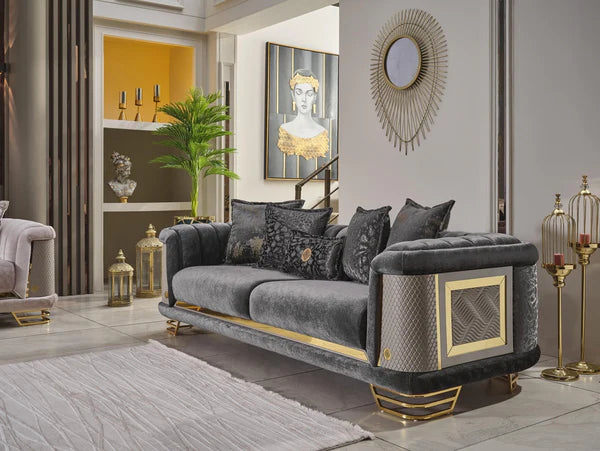
- Art deco and statement sofas from a collection like living room furniture tend to carry strong geometric lines already, so a simpler, quieter coffee table shape (a plain round or a low rectangular slab) keeps the sofa as the visual anchor rather than competing with it.
A good habit before buying: measure your sofa's length and aim for a coffee table that's roughly two-thirds that length. A 2.4m sofa suits a coffee table around 120-140cm, while a compact 1.8m two-seater is better matched to something closer to 90-110cm.
Console tables: entries, hallways and behind the sofa
A console table — traditionally defined as a table supported by brackets or a slim frame against a wall rather than a full four-legged base — does more work than people give it credit for. Used behind a sofa that floats in the middle of a room (common in open-plan Sydney living and dining spaces), it adds a surface for lamps, photo frames or a catch-all tray, and visually "closes off" the back of the sofa so the room doesn't feel unfinished from the kitchen or dining side.
For a behind-the-sofa placement, the console should be slightly shorter than the sofa itself and sit no taller than the sofa's back cushions, typically 75-85cm high. Leave a narrow gap of 5-10cm between the two rather than pushing them flush, which makes the space read as more intentional.
In an entryway or hallway, the sizing brief changes: a narrower depth (30-40cm) matters more than length, since the goal is a surface for keys and mail without eating into walking space. Sydney terrace hallways in particular often only have 90-100cm of clear width, so measure before falling for a wide statement piece.
Materials: timber, glass, marble and stainless steel
Material choice affects both the look and the day-to-day practicality of these pieces.
Timber is the most forgiving option for family homes. It hides dust and light scuffs well, adds warmth to a room dominated by leather or linen upholstery, and pairs with almost any sofa style. Solid timber will cost more but resists humidity changes better than veneer, which matters in Sydney's coastal climate.
Glass-top tables, often set on a stainless steel or black metal base, suit smaller living rooms because the transparency keeps the space feeling open rather than filling it visually. The trade-off is maintenance: glass shows fingerprints and dust noticeably more than timber or stone, so it suits households without young children better than busy family rooms.
Marble (or marble-look sintered stone) has become one of the most requested finishes for coffee tables in the last couple of years, and for good reason: it reads as a genuine investment piece and pairs particularly well with velvet and boucle sofas. Genuine marble is porous and can stain from red wine or citrus if left too long, so a marble top is a better fit for a formal or lower-traffic living room than one that doubles as an everyday family space.
Stainless steel and mixed-metal bases with glass or marble tops suit contemporary and art deco-styled rooms and are generally the easiest to keep clean, since a wipe-down is all they need.
Styling tips that make a real difference
- Use a tray to corral remotes and coasters on a coffee table. It keeps the surface looking styled rather than cluttered, and makes it easy to lift everything off in one motion when guests are over.
- Layer heights on a console table: a taller lamp or vase on one side, a shorter stack of books or a bowl on the other, rather than lining everything up at the same height.
- Leave roughly a third of the surface empty. A coffee table or console that's fully covered stops looking styled and starts looking like storage overflow.
- If your coffee table and console table are both being bought new, keep the materials related but not identical, for example a timber coffee table with a marble-top console, so the room feels coordinated without every surface matching exactly.
Choosing for your Sydney home
Apartment living rooms across the inner west and north shore tend to reward round or oval coffee tables and slim, wall-hugging console tables, simply because clearance is at a premium. Larger suburban homes with open-plan living and dining, common in growth areas further out, have more freedom to go with a larger rectangular coffee table and a full-length console behind the sofa as a genuine room divider.
Whichever direction suits your space, measure your existing sofa's seat height and length before you shop. It's a five-minute step that avoids the most common mistake in living room styling: a beautiful table that simply doesn't fit the sofa it was bought for.